The design of the mVista 3 ultra-high-end preamplifier is officially making progress. If you’ve ever been curious about the philosophy behind well-engineered gear, this short look into the design decisions offers some insight into achieving real-world high performance.
A preamplifier has one core job: to select sources and amplify a music signal without any degradation. (And, of course, to look cool while doing it.)
Knowing how well that job is done ultimately comes down to two things—subjectively, how well the music sounds, and objectively, how it measures. The parameters generally fall into two categories:
- Signal purity and distortion: How much the original signal is changed or degraded.
- Noise performance and dynamic range: How much the signal is interfered with, masked, or disrupted.
Signal vs. Noise: The Battle is Fierce
In the real world, electronics are never completely perfect. Some components are vastly better than others, often at considerable expense (such as internal wiring made of pure silver).
The core challenge in design is keeping noisy elements as far away as possible from the highly sensitive, music-carrying circuitry. This is achieved mechanically through physical separation and metal shielding, and electrically through careful circuit layout and signal routing. Where possible, sensitive sections can even be connected entirely without wires—an advanced isolation technique.
Of course, all electronics need power. While battery power works well in certain scenarios, it has clear limitations. Consequently, designing the power supply—managing ripple rejection, smoothing, and grounding—turns out to be the real black art of amplifier design. It’s the domain where engineering gurus earn their keep, and it remains a massive challenge even when money is no object.
mVista 3 Architecture Decisions
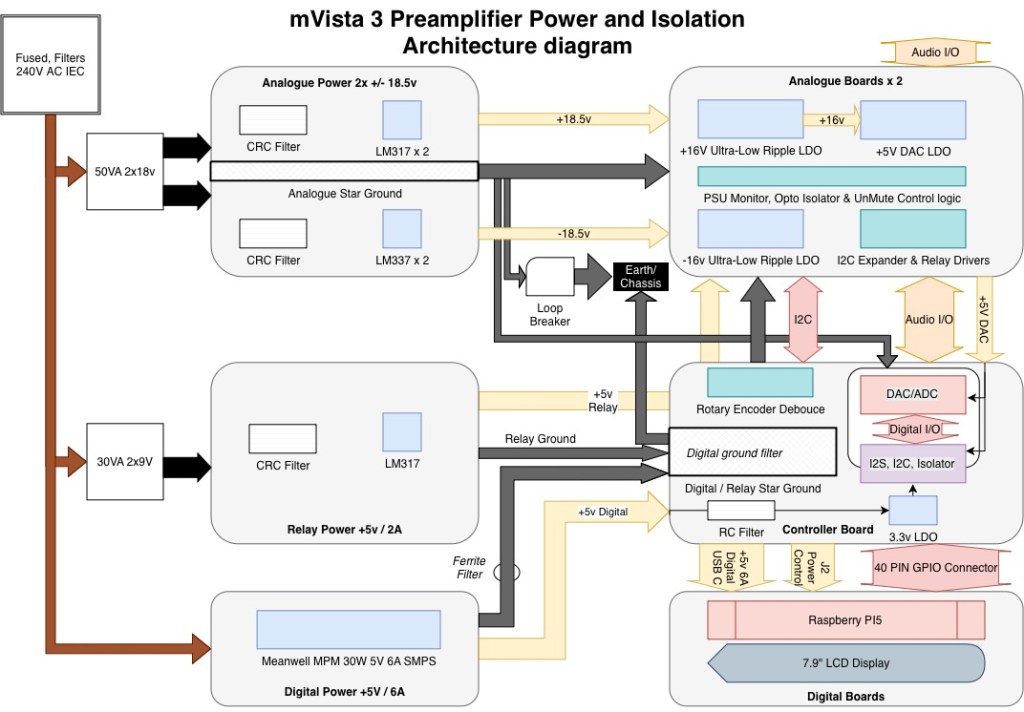
I’ve used every trick in the book for this architecture. In particular, the isolation methods keep the display and digital computing sections entirely separate from the pure analogue circuitry. There are ten power supply’s altogether and a digital controller section to link it all together
When it comes to the analogue power supply, think of it like making pasta through a machine. The first pass gets most of the rough bumps out and the shape right. The second pass strips away all the nasty noise coming in from the mains electricity. The final pass irons the power so flat and smooth that it’s like the music is wrapped in silk.
Ultimately, the proof of the pasta will be in the listening.


Leave a comment