
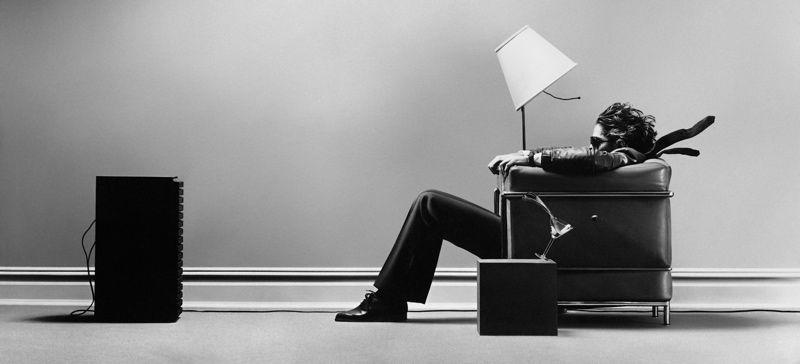
Audiophile gear can get expensive, so getting the most out of what we have already makes great sense. In the blog “What element most drives Sound Quality”, we discussed factors associated with the gear itself. Let’s focus on the factors to do with how the gear is set up, located, and positioned.
Human hearing is incredibly sensitive. In fact, it is more sensitive than we can reliably measure. If a wasp buzzes, you will turn round to see it – it’s remarkable how our ears can perceive tiny changes in sound pressure, filtered out by your brain to know it was a wasp coming in for the sting. Bear this in mind when trying to improve sound quality – tiny, tiny changes really can make a difference.
Quieten the room
All rooms affect how a system sounds and usually our rooms are living and family spaces. This places limitations on what can be done – but sometimes some small changes can make a difference.
A completely dead room (called an anechoic chamber) has zero reflections, and the sound heard is exactly that coming out of the speaker – this is used by speaker manufacturers for design tuning purposes. I am sure you and your family will not want to live this empty, unnatural space.
Standing in the room, clap your hands and listen carefully to how it sounds. Does the sound die away quickly or can you hear a faint echo, like you hear in a large space like a cathedral? This echo, termed reverberation, is caused by the sound bouncing off walls, windows and hard surfaces. Here a few things that can be done:
- Place a rug on hard floors, especially between the listener and the speakers
- Move the speakers away from windows
- Use room correction equalisation that is often built into streamers these days. Its a bit tricky to set-up but can null out some nasty nulls and peaks
- Add some more cushions and curtains
- Treat the wall with sound-dampening material. Ok this is not free, but a rug on the wall would be the next best thing!
Move the speakers
Sometimes for practical reasons speakers are placed up against the wall. This has a similar affect as cupping your hands around your mouth when you speak. The sound is muted and can be muffled. Loudspeakers are designed to move air and need space. The bass especially, moves a lot of air and speakers have holes (called ports) to allow the air inside the speaker to flow out and contribute to the overall sound.
Look at your speakers, is there a port at the back, front or bottom? Rear ported speakers, especially, ideally need at least 30cm from a wall, ideally 50cm or more. Even if it’s not practical, just try moving the speakers away from walls and see how the sound changes.
Subwoofers are especially sensitive to where they are placed in the room. This is because the sound waves at lower frequencies bounce around and sometimes cancel out and reinforce, just like waves on the sea. Try moving the subwoofer 10 cm left, right, forwards and backwards on tracks with lots of bass. The pattern of wave cancellation and reinforcement will change. This technique, called the “sub-woofer crawl”, is all about finding the best place (yes, audiophiles are a bit weird!).
If you have bookshelf speakers, place them on stands. These are designed to go on stands and the cones should be at about ear height. Again, they need space around them to freely produce and disperse the sound. Experiment with different positions.
Find the sweet spot
Some speakers really can be quite directional, and how the sound travels to the listener is often surprisingly complex. Many manufacturers recommend setting the speakers up in a triangle. Typically 3-5m apart and about the same distance to the listener – this all depends on the size of the speakers and the room. This places the listener in a “sweet spot” equidistant from each speaker.
Next, try “toeing” in the speakers. This is about pointing them very slightly towards the listener. This can make quite a difference to the stereo imaging effect, the sound balance and how “wide” the soundstage can appear. Well-set-up systems sound like music is perfectly placed in space, the background is very quiet, and the quiet recorded reverberation makes you feel like the sound is coming naturally from beyond the speakers.
Noise
Noise is the technical term for unwanted interference. Hiss, clicks, pops, and muffled sound are all types of noise. Noise has an insidious effect of clouding details, losing information, and polluting how systems are intended to work.
There are many sources of noise and some you can influence. The mains power running into your gear has come a long way. Even just in your house, your dishwasher, hoover or tumble dryer dump much electrical noise. Good equipment and wiring can eliminate much of this – but if you can choose to power your hifi from a separate circuit – this helps. At least, don’t have your washing machine plugged in next to your amp!
Mobile phones, wifi routers, bluetooth, phone chargers, lights all make lots of noise. Have you heard the clicks from your phone on your system? The simple answer move all this stuff as far away as you can. Switch off dimmed lights. So don’t have your wifi router plugged in near your gear; don’t have a phone charger in the same power block.
I use an iPad to control what I am listening to and my phone in my pocket. This all uses WiFi, but at 4m away, it has negligible impact.
Clearly, this is a large and complex topic. Let me know your experiences – what have you managed to change that has made a difference for free?


Leave a comment