This is the question in Audiophile circles that causes more debate amongst listeners, reviewers, engineers and vendors than almost anything else.
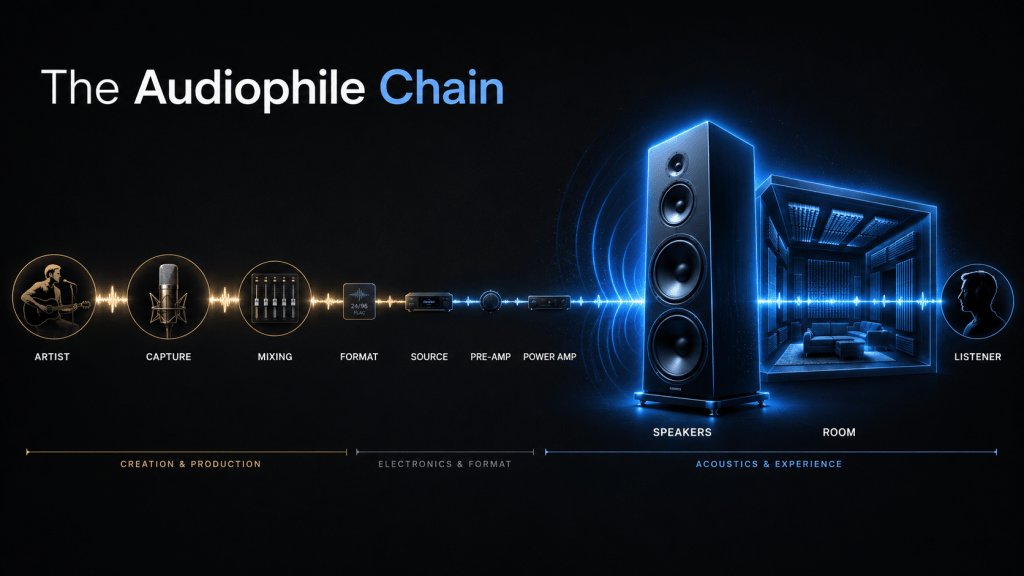
Ultimately, the pursuit of high fidelity audio is a process of optimisation of all these elements. I like to call this the Audiophile Chain – each component or element is a step on the journey from the artist all the way to listener.
Audiophile Chain
Everything starts with the artist. They may be recorded on a stage, in a studio or the sound may only ever be generated on a computer. The history of how the recording industry has developed over the last 100 years is a fascinating topic for another day. There are so many different ways, techniques, equipment and media to choose from. The most common end result of the recording process today is an uncompressed high-resolution digital file (often 96kHz or 192kHz at 24-bit). While digital recording overtook tape masters in the 1990s, today’s file resolutions are higher than ever.
Source format, too, has changed over the years. Vinyl pressings and tape dominated until digital technology improved. This gave rise to CDs, SACDs, and DATs at 44.1kHz/16-bit (aka “Redbook”). Compression is a digital source that makes transporting audio considerably more convenient, giving rise to iPods and streaming. All streaming services for mobile phones have compressed versions, and many now offer uncompressed “hi-res” versions, sometimes back to 192/24.
As humans we listen with our ears and not in 1’s & 0’s. A digital-to-analogue converter transforms the music to analogue signals. To hear them, a chain of amplifiers increases the voltage and then the current in the power amplifier, sufficient to move the cones in the loudspeakers.
The loudspeakers have to move the air in the room to reproduce sound that we can hear. The sound is dispersed from the speaker and reaches our ears directly and indirectly, bouncing off walls and furniture. Each room is different, and the way the sound reaches can come from several paths at once – this introduces delays (heard as reverberation and echoes) and colour, as frequencies resonate to make them louder and cancel to make them quieter.
Where should I spend my money to improve Sound Quality?
Everyone has an opinion on this!
In my opinion, every element in the audiophile chain has an influence, but they are not all equal. This means that only when the elements that have the greatest impact have been addressed does the contribution of the others start to become appreciable.
If I had to put the Audiophile chain in order of impact, this is my sequence:
- 🏠 The Room: Acoustic reflections and reverb can destroy even a £10,000 system.
- 🔊 The Speakers: The physical transducers that push the air.
- 🎛️ The Recording/Mastering: A bad mix will always sound bad.
- 💿 The Source Format: CD, Vinyl, or Hi-Res Stream.
- 🔌 The Amplification & Electronics: Crucial, but ultimately bound by the elements above.
In other words, the room needs to be “quiet” and not add too much colour or reverb. The speakers need to be matched to the room – not too large or too small. The recording needs to be well made. The difference in a recording is dramatic. Also, the difference in how the same album is transferred to vinyl and CD is often quite different.
I have come to the conclusion that money needs to go where it matters. Most of us don’t have treated listening rooms so a proportionate set of loudspeakers and an appropriate amp is a given. The next thing that can be controlled is the source, so an adequate turntable or DAC + CD/Streamer is necessary. Equally, there is no point spending £5k on a DAC playing through a £1k pair of speakers.
If I were to advise someone buying a system from scratch this would be my rule of thumb.
- 30-50% of the budget on Speakers
- 20-40% on the amp
- 20-40% on the source
- Ideally, save money on gear and buy great records & CDs
Law of diminishing returns
There is no shortage of amazingly capable gear available today. Better than ever before. And if you include the second hand market, ever more so.
The love of great audio (Audiophilia) is addictive – once you make your setup sound better, you want to keep going. This is where cabling, isolation, and power distribution become factors, and I have definitely heard the difference these incredibly subtle factors can make. But there is no point in putting rear spoiler on a mini to increase grip at 70 mph.
However, spending twice as much does not necessarily make the enjoyment twice as good. But there is so much that can be done, affordably, which makes this hobby curious, vibrant and interesting.
I have expressed my views. What do you think matters most in enjoying great sounding music?


Leave a comment